Background:
Of the many departures our country has made from our Founders’ vision, the runaway growth of the executive branch may be the most egregious. Instead of a single executive elected by the people, we have a swarm of entrenched bureaucrats, effectively insulated from popular accountability.
The Framers of our Constitution vested executive power in a single person, the President. In Federalist 70, Alexander Hamilton argued that this unity was necessary to provide the executive branch with the “energy” needed to ensure effective government. Furthermore, Hamilton cautioned that plurality in the executive “tends to conceal faults and destroy responsibility.” Today’s sprawling federal bureaucracy, riddled with waste and abuse, vindicates Hamilton’s warning.
During the twentieth century, we abandoned our Founders’ vision for the executive branch and steadily shifted power to an unelected and unaccountable administrative state. This transformation was aided by the Supreme Court’s 1935 decision in Humphrey’s Executor, which protected the heads of certain executive agencies from presidential removal. Landmark is fighting to overturn Humphrey’s Executor, which we believeis a crucial step in reviving constitutional separation of powers. The Supreme Court recently heard Trump v. Slaughter, a direct challenge to Humphrey’s Executor. Based on the Justices’ questions, we think it is likely that they will overturn Humphrey’s Executor and deliver a great victory for constitutional separation of powers.
Legal History: Myers v. United States:
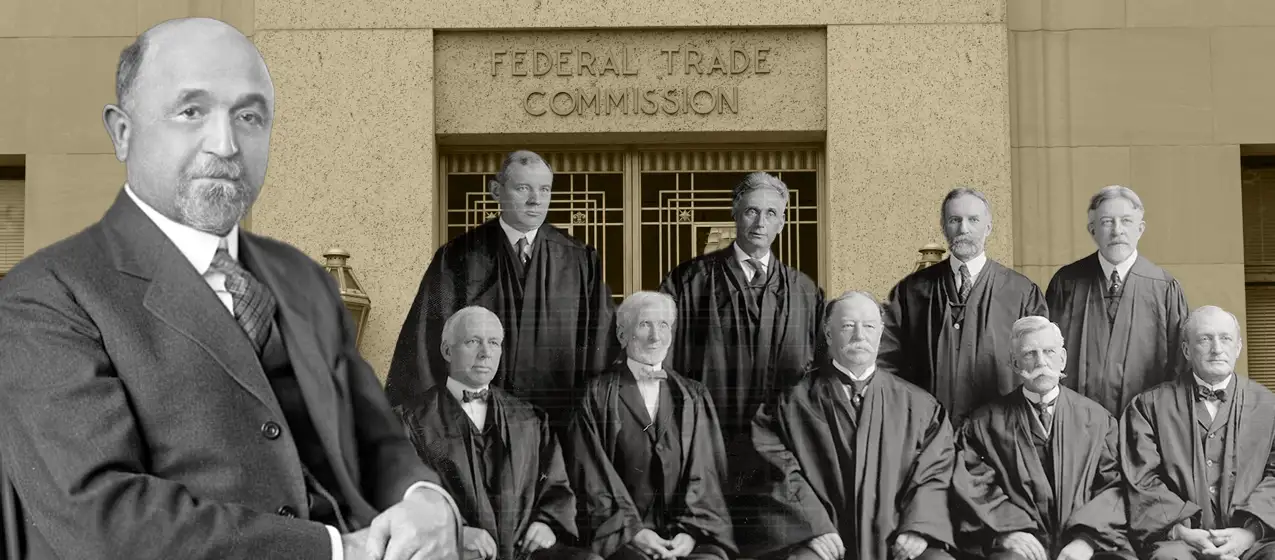
During the early twentieth century, progressive leaders like Woodrow Wilson rejected Hamilton’s vision of a unitary executive. Instead, they proposed shifting power to administrative agencies, which would be staffed by apolitical experts. In 1914, Wilson signed the Federal Trade Commission Act, which included a provision barring the President from firing FTC Commissioners except in cases of “inefficiency, neglect of duty, or malfeasance in office.” This provision was at odds with the Constitution’s separation of powers doctrine and should have been quickly struck down. In 1926, Myers v. United States seemingly established a precedent that would have doomed the FTC’s removal protections. In a case involving the removal of postmasters, Chief Justice William Howard Taft ruled that Congress could not prevent the President from firing executive branch officials.
Humphrey’s Executor:
However, when the FTC Act reached the Supreme Court in 1935, the Court sidestepped the Myers precedent and upheld the removal restriction. Justice George Sutherland, writing for a unanimous Court, ruled that, because the FTC was a “quasi-legislative or quasi-judicial body,” Congress could shield its commissioners from presidential removal.
This novel line of reasoning created a class of unelected federal administrators who exercised executive authority without accountability to the elected President.
The Humphrey’s Executor Court distinguished its decision from Myers by claiming that Myers applied only to officers engaged in “purely executive power,” suggesting that administrators who perform even the smallest bit of a legislative or judicial function in the exercise of executive power might be protected from removal.
This concern is not hypothetical. Landmark previously filed a brief in the successful challenge to the structure of the Consumer Financial Protection Bureau (CFPB), an agency designed primarily by Senator Elizabeth Warren following the 2008 financial crisis. The CFPB was given massive regulatory powers, leveling billion-dollar fines and policing the speech of mortgage lenders. The enabling statute protected the CFPB’s director from removal and the agency was permitted to draw funds directly from the Federal Reserve, bypassing the congressional appropriations process and leaving the voters with no effective control over this mammoth agency.
Read more about Landmark’s fight against the CFPB here.
Trump v. Slaughter:
As President Trump has attempted to tame the administrative state by firing administrators who do not align with his policy goals, his efforts have been thwarted by judges who rule that Humphrey’s Executor prevents him from firing them. Trump v. Slaughter is a challenge to Humphrey’s Executor. Rebecca Slaughter is a Federal Trade Commissioner who President Trump attempted to fire. The D.C. District Court ordered her reinstated, citing Humphrey’s Executor. The Trump administration appealed and, on September 22, the Supreme Court agreed to hear the case.
Landmark’s Brief:
Landmark submitted a brief urging the Supreme Court to overturn Humphrey’s Executor. In our brief, we argue that the FTC is and always has been an Executive Branch agency. Its legislative and judicial functions, including occasionally providing reports to Congress and serving as a master of chancery, are clearly secondary to the main purpose of the agency: regulating competitive markets and enforcing antitrust law. These primary roles are executive in nature and have been the main purpose for the agency since its founding.
Additionally, we raised the issue of highly partisan appointments over the past several decades. Humphrey’s Executor justified sharply limiting Myers by describing the FTC as a nonpartisan body of experts. This has not proven to be the case. Our brief demonstrates that, since the Kennedy administration, only three FTC commissioners can reasonably claim to be nonpartisan. For example, prior to her appointment as an FTC commissioner, Rebecca Slaughter served as Chief Counsel to Senator Chuck Schumer.
Read Landmark’s brief here.
Oral Arguments:
During oral arguments, United States Solicitor General D. John Sauer claimed that, because the Constitution vests all executive power in the President, the President must have control over executive officers, including the power to remove them at will. He contended that the FTC’s statutory removal protections violate Article II of the Constitution and the separation of powers.
Questioning from the Justices indicated that a majority were open to this position, although some were concerned about the consequences of overturning Humphrey’s Executor, particularly in regard to the Federal Reserve. Sauer argued that the long history of American central banking and its semi-private structure insulate the Federal Reserve’s leadership from future constitutional challenges.
A decision will be released before the Court’s term concludes at the end of June. Based on oral arguments, we are optimistic for a good outcome.