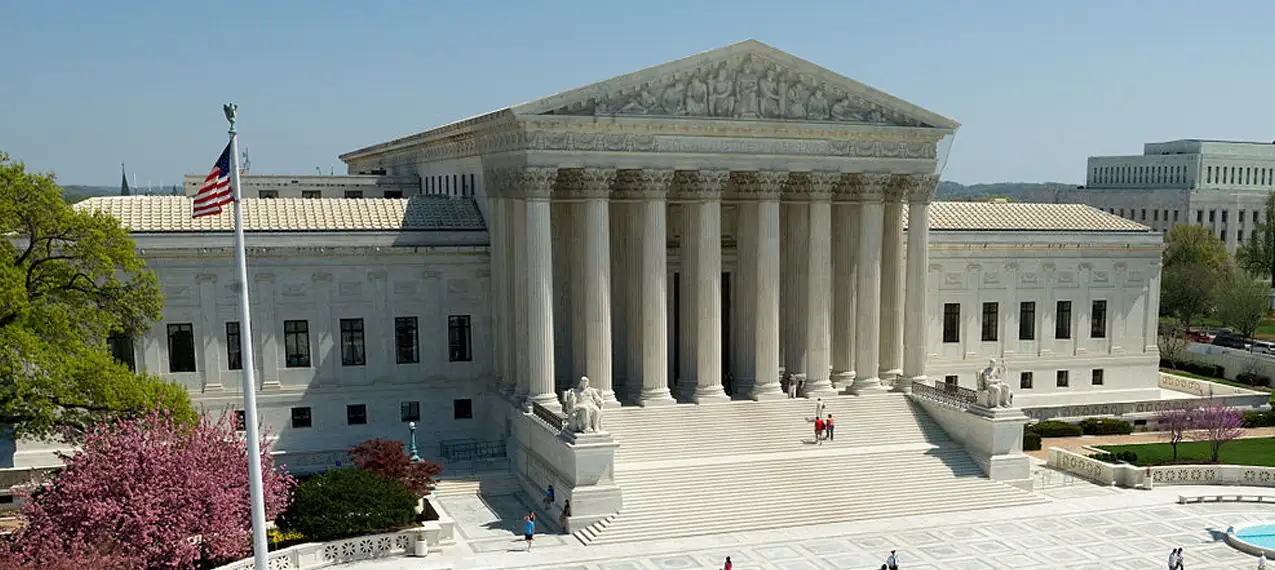
Even on Election Day, it’s business as usual at the Supreme Court.
On November 5, three of Landmark’s McDowell Fellows attended oral arguments in E.M.D. Sales v. Carrera. Attending these arguments was important because Landmark authored an amicus brief on behalf of the National Association of Wholesaler-Distributors and International Foodservice Distributors Association in support of Petitioners.
E.M.D. Sales concerns the standard of proof courts apply when determining the applicability of exemptions to the Fair Labor Standards Act’s (FLSA) minimum wage and overtime provisions. The FLSA provides exemptions, including one for an “outside salesman” (29 U.S.C. § 213), invoked in this case.
Petitioners, E.M.D. Sales, Inc., pointed out the lower preponderance of the evidence standard is the default standard for civil litigation. The FLSA does not contain any directive to use the higher clear and convincing standard. Moreover, the FLSA does not convey any unique rights that would justify using the higher standard. Advocates for Petitioners noted that even in cases involving important rights, such as discrimination or workplace safety cases, courts apply preponderance of the evidence.
In contrast, Respondents, former employees of E.M.D. Sales, argued for a “clear and convincing” evidence standard in FLSA exemption cases. They stated that minimum wage and overtime provisions are important both as individual rights and necessary to preserve economy-wide standards for compensation and fair business practices. Respondents also argued that the FLSA is not a typical civil statute, and that a clear and convincing standard is necessary to fulfill the purposes of the act.
When Justices Alito and Kagan asked Respondents’ counsel to provide methodology or examples for when the higher burden of proof should be used, counsel responded ambiguously. The Justices appeared unconvinced by the argument that FLSA exemption cases are unique and important enough to warrant a higher evidentiary standard. Justices referenced discrimination or welfare cases as being as important as FLSA cases but using preponderance of the evidence standard. Justice Kagan requested that Respondents’ counsel elaborate how non-waivability, the fact that an employee cannot surrender their right to overtime pay, makes FLSA cases unique. Counsel responded that if FLSA provisions were waivable, then it would nullify the purpose of the FLSA.
The Justices appeared skeptical of applying a higher evidentiary standard. A decision should be issued sometime in the Spring.
The Fellows arrived at the Supreme Court around 6:30 AM to secure their place in line. The oral arguments were surprisingly well attended. Turnout was expected to be low on election day, but the line for public entry had already exceeded sixty when the Fellows arrived. By 9:30 AM, the Court began to admit the audience. The highlight of the day was to simply sit and observe the Justices; to take in the atmosphere of the room in which so much of our great nation’s history has been decided. Landmark recommends that all who are able go in person to witness for themselves the inner workings of our land’s highest court.
Listen to the oral arguments in E.M.D. Sales v. Carrera here.